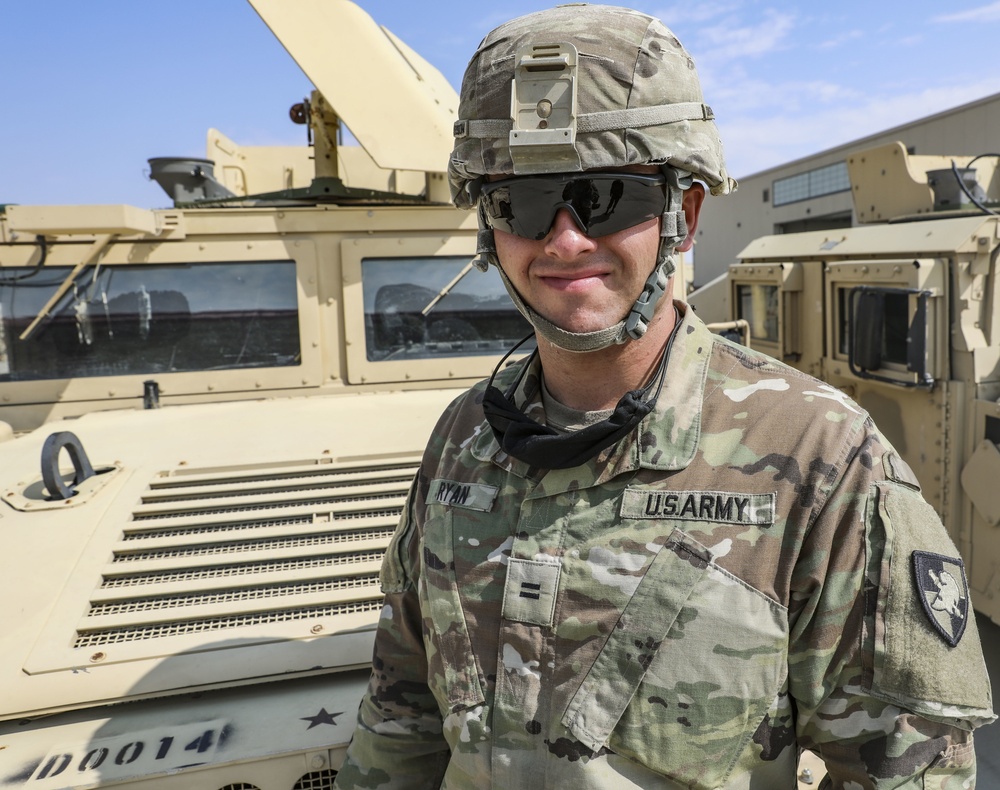
1st Armored Division gives cadets from Reserve Officer Training Corps programs and military schools, like the United States Military Academy, the opportunity to be immersed in the day-to-day day operations of Army life, allowing them to serve in leadership positions as part of a U.S. Army Cadet Command summer training program called Cadet Troop Leader Training.
In the program, cadets assume the role of a
platoon leader under the mentorship of a 1st AD officer sponsor for three weeks
during the summer.
Capt. Thomas Hinkle, CTLT lead for the 1st Armored
Brigade Combat Team, 1st AD, explains that the significance of CTLT is showing
cadets what the U.S. Army is really about.
"Cadets come when they're rising juniors in
college and pair up with a lieutenant," Hinkle stated. "The CG's
directive is for the cadets to assume a leadership role, rather than purely
shadowing a platoon leader providing a firsthand experience of their branch."
Additionally, Hinkle described how the cadets
arrive at America's Tank Division from all across the country.
"Cadets come from literally all over. The
first cohort of cadets is usually from West Point. As the summer continues,
cadets arrive from ROTC programs across the country," Hinkle discussed.
The program itself is voluntary, except for West Point
cadets.
"For West Point, they all have to do a CTLT
summer rotation because it's part of their curriculum and a graduation
requirement," he stated. "For ROTC cadets, they receive a certain
number of slots, which are voluntary, and a great leadership opportunity if
they decide to participate."
Two CTLT cadet participants from West Point, Cadet
Lt. Madeline Biscaichipy and Cadet Lt. Kevin Fernandez, provided feedback from
their CTLT experience with 1st AD.
Biscaichpy, a Los Angeles, California, native who
desires to branch Field Artillery, said she had a fantastic time at Fort Bliss.
"It's amazing to see how many Soldiers work
here on Fort Bliss and how much gets done daily, especially from 2-3 Field
Artillery Battalion where I was assigned, and other tenant units," she
proclaimed.
Fernandez, a Miami, Florida, native who desires to
branch into engineering or cyber, described how this program allows
experiential learning of how the Army operates beyond classroom academics and
word-of-mouth experience from West Point instructors.
"We are always told West Point is not the
Army. West Point's curriculum focuses on training and teaching young officers,
especially academics, but coming here, it's our first time seeing what a real
active-duty unit is doing structured toward winning America's wars. I've been
lucky enough to hop around from staff shops to actual line platoons and see how
the Army is truly a team of teams," he added.
Overall, the CTLT program is mutually beneficial
for the Division and cadets. Hinkle discussed the magnitude of cadet
accomplishments through the program.
"Talking with the different sponsors,
battalion staff, and command teams, who feel cadet contributions are well
received and appreciated. The cadets are active participants and contributors
during meetings," said Hinkle.
Col. Kirby Dennis, 1st Armored Brigade Combat Team
commander, summed up the sentiments of the CTLT cadets best when he said,
"During his interactions with the cadets, they're always asking very, very
well-thought-out questions. You would not expect these questions from a junior
college student, yet they ask them."
Post a Comment